Bambu Lab R1 Released
Thursday, August 20, 2026 · Time not confirmed
Where to Buy
Affiliate or partner links may earn a commission at no extra cost to you. As an Amazon Associate I earn from qualifying purchases.
Details
- Brand / Manufacturer
- Bambu Lab
- Product type
- Desktop CO2 Laser Cutter and Engraver
- Model
- R1
- Key specifications
- 55W CO2 laser, speeds up to 1000 mm/s, cuts up to 20 mm thick acrylic in a single pass, automatic optical path alignment, Class 1 laser safety
- Region Availability
- USEUCAGlobalUKAU
Release information
Pre-orders opened on official store channels following the launch reveal on September 22, 2026, with an MSRP of $2,499 USD or €2,499 in Europe. Official storefront listings estimate that initial order shipping will begin around November 6, 2026.
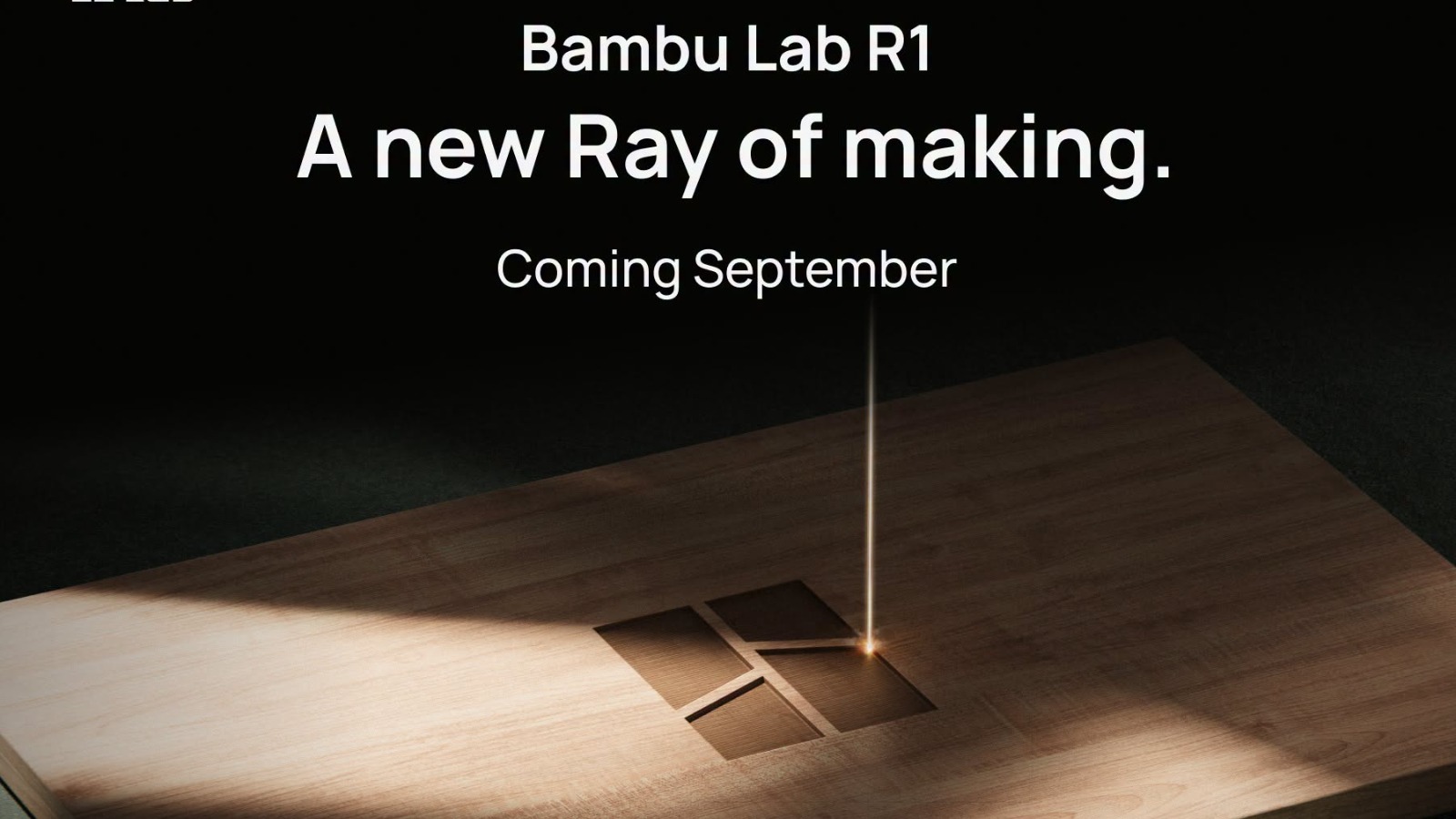
The Bambu Lab R1 represents the manufacturer's initial expansion from 3D printing into desktop laser fabrication. Built around a 55W CO2 glass tube with internal water cooling, the device adapts motion control technology and automated optical alignment into a desktop laser cutting platform.
Operating within a dedicated software setup, the system pairs with Bambu Suite on macOS and Windows while automatically recognizing parameters for supported materials. Additional hardware add-ons allow users to expand the stock work area for long material panels and cylindrical projects.
What we know
Bambu Lab announced its entry into the desktop laser cutting market with the official reveal of the R1, a 55W CO2 laser system. The machine marks a broadening of the company's product line beyond 3D printers while adapting its established motion control algorithms.
The hardware features a 600 by 300 mm bed size capable of processing wood, leather, glass, fabric, slate, and anodized aluminum. Utilizing a glass tube CO2 laser with integrated water cooling allows the system to engrave and cut materials like clear acrylic and thick hardwoods that diode lasers cannot process.
Features and specs
Workpiece setup relies on the TriSense positioning system, which combines an overhead camera, a toolhead camera, dual lasers, and spatial encoders. The sensor array tracks curved, uneven, or transparent materials to maintain accurate height measurement across diverse surfaces.
Automated optical calibration utilizes a sensor mounted to the toolhead that measures the beam path and corrects alignment in approximately one minute. An onboard color touchscreen allows users to oversee job progress, view calibration status, and inspect machine diagnostics directly without needing a connected computer.
Motion systems borrowed from Bambu Lab 3D printers include active vibration compensation and dynamic laser power adjustments. The machine delivers accelerations up to 20,000 mm/s², ensuring consistent engraving depth even during high-speed directional changes.
Safety and ventilation
Airflow management uses a corner-to-corner crossflow ventilation design that introduces fresh air from one side of the enclosure while exhausting smoke from the opposite side. Continuous airflow across the workspace helps eliminate dead zones where fumes might otherwise accumulate during long cutting runs.
Operational safeguards include internal flame detection sensors, lid-open safety switches, an emergency stop control, and an integrated automated fire suppression system. The fully enclosed housing contains laser radiation during standard operation.
Accessories and workflow
Software connectivity integrates directly with the proprietary Bambu Suite application for Windows and macOS, alongside seamless links to MakerWorld user accounts. Third-party control software like LightBurn is not supported at launch, maintaining a fully native workflow.
Extended capabilities depend on optional accessories that are sold separately from the main system. An optional auto-feed conveyor enables processing of board stock up to 3 meters long, while an optional Vision Encoder increases absolute positioning accuracy to within 0.1 mm.
Additional add-ons include a rotary attachment for curved items, riser bases for tall stock, alternative focal length lenses, and the E1 Pro multi-stage air purifier. Installing pass-through extensions like the riser base or conveyor converts the enclosure from a Class 1 setup into a Class 4 device, which requires operators to wear laser safety eyewear.
Pricing and availability
The standard system carries an official price tag of $2,499 USD in North America and €2,499 in European territories. The base package ships with the laser machine and a short-focus lens included.
Following its official announcement on September 22, 2026, pre-orders opened on the manufacturer's direct online store. Order fulfillment and product shipments are scheduled to commence in early November 2026.
Frequently asked questions
- When does Bambu Lab R1 2026 release?
- Bambu Lab R1 2026 is scheduled to release on Thursday, August 20, 2026 (exact time not yet confirmed).
- What software does the Bambu Lab R1 use?
- The R1 works exclusively with Bambu Suite on Windows and macOS and integrates with MakerWorld. Third-party software such as LightBurn is not supported at launch.
- Does operating the Bambu Lab R1 require laser safety glasses?
- Safety glasses are not required when operating the machine in its fully enclosed baseline configuration. However, using open extensions like the optional Riser Base or Conveyor alters the safety rating to Class 4, which requires laser safety eyewear.
- What is included with the base $2,499 price?
- The baseline $2,499 package includes the R1 machine unit and a short-focus lens. Optional accessories such as the Vision Encoder, Conveyor, rotary attachment, and E1 Pro air purifier are sold separately.
- How does the automatic mirror alignment feature work?
- Automatic optical alignment is handled by attaching a dedicated sensor to the toolhead. The sensor measures beam positioning and automatically corrects optical path misalignments in about one minute without manual test grids or thermal paper.
Last updated: 11/14/2026