Space
SpaceX Falcon 9 rocket will crash into the moon Released
Wed, August 5, 2026 at 6:35 AM UTC
Released
Wed, August 5, 2026 at 6:35 AM UTC
44 days ago
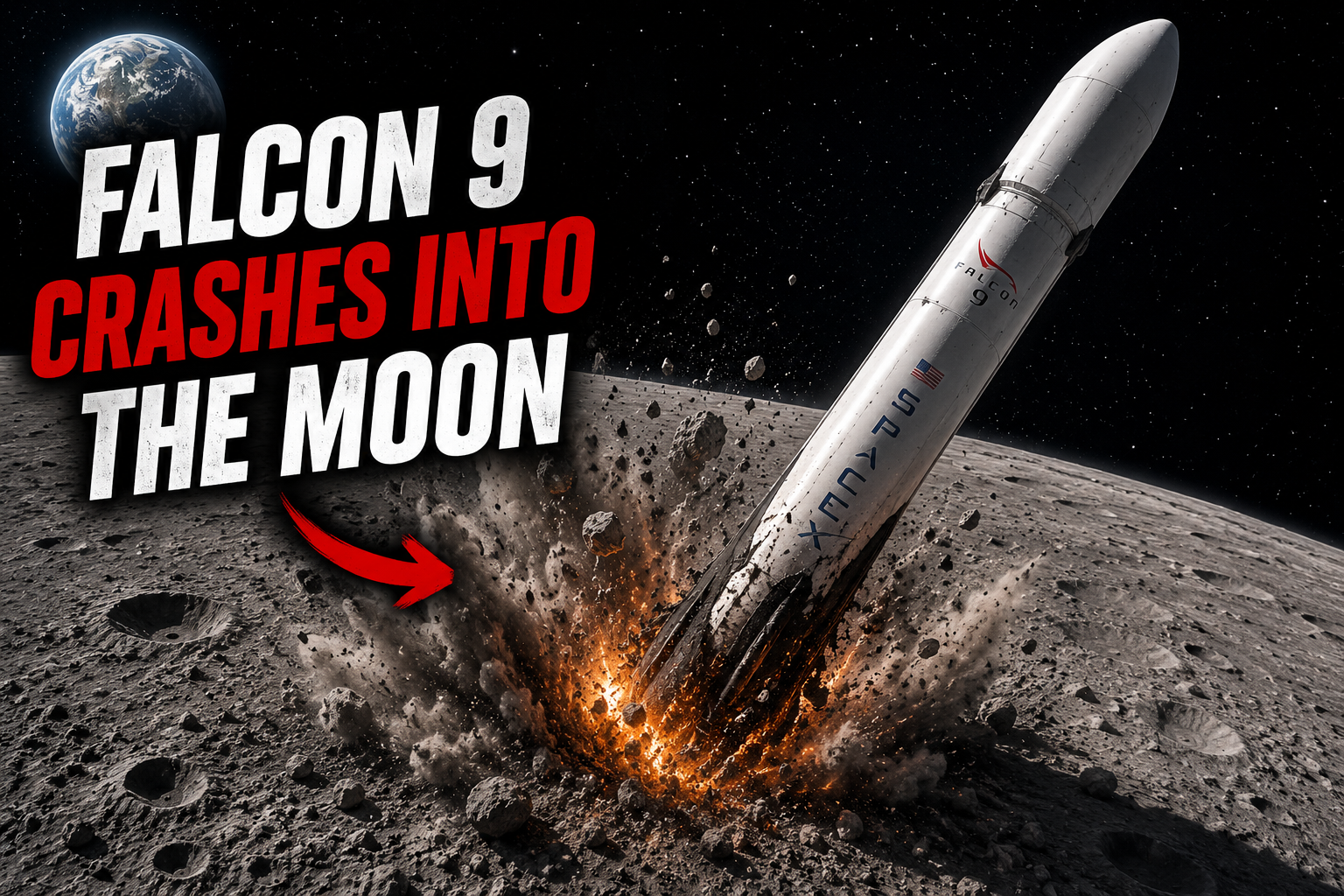
Following a launch from Kennedy Space Center in January 2025, a spent rocket upper stage was left drifting in a long, looping orbit. Over approximately 18 months, subtle gravitational nudges from the Sun, Earth, and other celestial bodies gradually shifted the object's trajectory onto a collision course.
Striking the daylight side of the surface at an estimated 5,400 mph (8,700 km/h), the five-story structure, weighing roughly 4,000 kilograms, is expected to carve out a fresh crater between 17 and 30 meters wide.
Because the mass, speed, and trajectory of the hardware are known in advance, planetary geologists view the event as a rare controlled impact experiment. NASA's Lunar Reconnaissance Orbiter and South Korea's Danuri spacecraft, alongside ground-based observatories, plan to gather pre- and post-collision data to study cratering physics, dust ejecta plumes, and seismic waves. These findings will help engineers design safer habitats, landers, and orbital paths for future missions.
Details
- Vehicle or Subject
- Falcon 9
- Organization or Agency
- SpaceX
- Location
- Moon
- Payload or Details
- A pair of lunar landers and scientific instruments
- Destination / Orbit
- Moon (near Einstein Crater)
Frequently asked questions
- When is SpaceX Falcon 9 rocket will crash into the moon?
- SpaceX Falcon 9 rocket will crash into the moon is scheduled for Wed, August 5, 2026 at 6:35 AM UTC.
- Will the impact be visible from Earth?
- The collision occurs on a sunlit portion of the surface, producing a brief flash and dust plume that are too faint for amateur skywatchers or binoculars to detect. Professional observatories equipped with high-powered equipment in dark regions may capture data, while orbiting spacecraft will collect imagery for analysis in the days following the event.
- Was the crash intentional?
- No, the impact was unintended. The defunct upper stage was discarded after completing its primary objective, and natural gravitational interactions over an 18-month period slowly pulled it into the surface.
- What scientific insights do researchers expect to gain?
- By analyzing the size of the new crater, the distance debris travels, and the resulting ground tremors, scientists can refine impact models. This research provides practical information on how high-velocity debris and seismic energy might impact future astronauts and surface infrastructure.
- What time does SpaceX Falcon 9 rocket will crash into the moon 2026 release in my timezone?
- The countdown on this page converts SpaceX Falcon 9 rocket will crash into the moon 2026 to your local time automatically, so the clock always reflects your own timezone.
Last updated: 9/4/2026