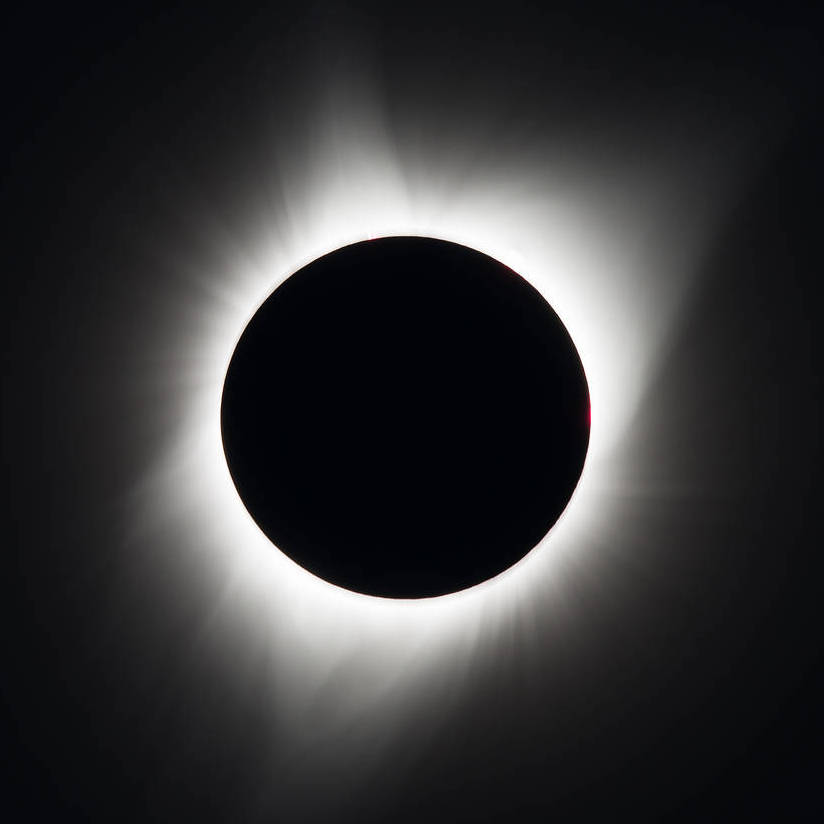
Annular Solar Eclipse Countdown
Sat, February 6, 2027 at 4:00 PM UTC
Details
- Location
- South America and Africa, including Chile, Argentina, Uruguay, Brazil, Ivory Coast, Ghana, Togo, Benin, and Nigeria
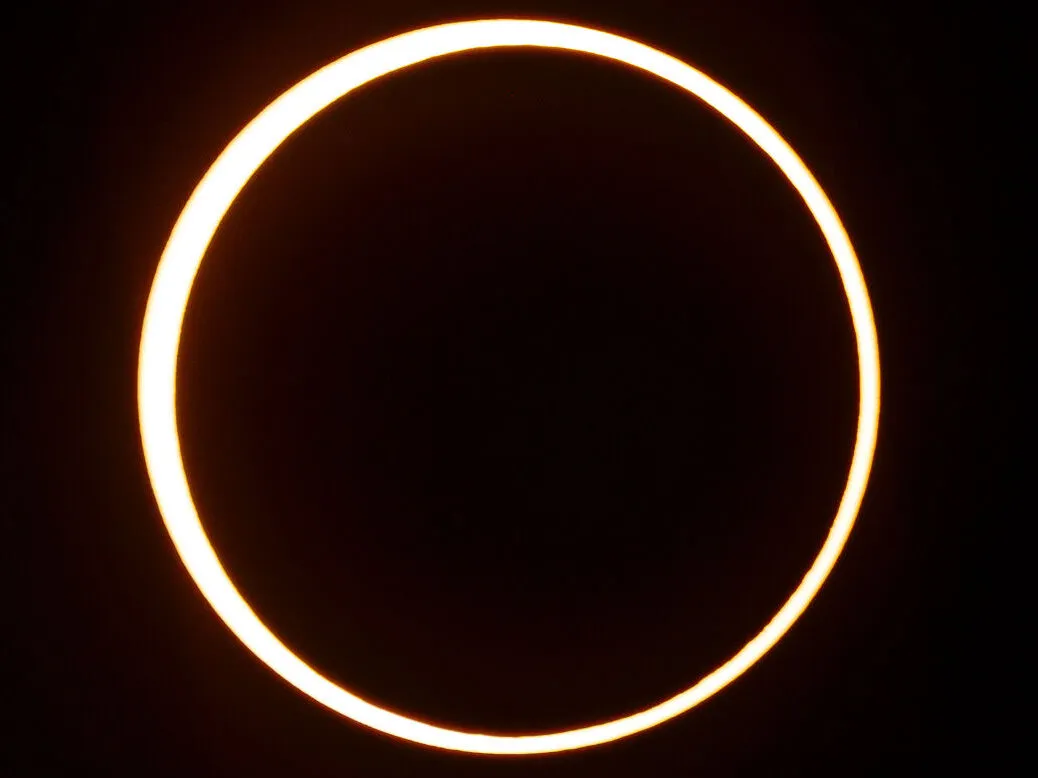
An annular solar eclipse occurs when the Moon passes directly between Earth and the Sun while positioned too far away in its orbit to completely block the solar disk. This leaves the outer edges of the Sun exposed, creating a bright ring of sunlight often referred to as a ring of fire. Specialized solar viewing protection is required at all times when observing an annular eclipse directly.
What we know
An annular solar eclipse takes place when the Moon passes directly between Earth and the Sun while positioned too far away in its orbit to completely cover the solar surface. This alignment leaves the outer edge of the Sun exposed around the dark lunar silhouette, producing a visible ring of sunlight often referred to as a ring of fire.
Directly observing an annular solar eclipse requires specialized solar viewing protection at all times to prevent severe damage to the eyes. Because the Moon does not fully obscure the solar surface during annularity, looking directly at the Sun without certified solar filters is unsafe throughout the entire duration of the event.
Observing partial phases
Along the outer boundaries of the main trajectory, extensive surrounding regions will witness a partial solar eclipse rather than a complete ring of fire. Observers within these partial eclipse zones will see the Moon obscure only a portion of the solar disk.
Surrounding regions expected to observe the partial solar eclipse include Antarctica, the South Pacific Ocean, and the South Atlantic Ocean. The proportion of the Sun covered by the Moon in these regions varies based on an observer's precise geographic location relative to the lunar shadow path.
Solar eclipse atmospheric research
Space agencies frequently utilize solar eclipses to examine structural changes in the upper atmosphere caused by sudden drops in sunlight. NASA previously conducted the Atmospheric Perturbations around Eclipse Path research mission, abbreviated as APEP, to study these ionospheric effects.
The APEP mission derives its name from the cosmic world serpent in ancient Egyptian cosmology. According to ancient myth, the serpent pursued the sun god Ra and periodically attempted to consume the solar disk, causing a solar eclipse.
Led by principal investigator Dr. Aroh Barjatya of Embry-Riddle Aeronautical University, APEP utilized Black Brant IX sounding rockets launched from facilities like White Sands Missile Range and Wallops Flight Facility during past eclipses. Launches were conducted in sequence prior to peak eclipse, during peak coverage, and after peak coverage.
Sounding rocket payloads and objectives
Rockets deployed for eclipse ionospheric studies carry scientific instruments designed to capture real-time atmospheric data. Payloads include Langmuir probes, electric field probes, magnetometers, ionization gauges, and accelerometers to measure electrodynamics and neutral dynamics.
Each primary payload also ejects four deployable SWARM units equipped with specialized sensors to provide simultaneous multipoint measurements. These tools collect data on mid-latitude ionospheric irregularities, temperature gradient instabilities, and small-scale structural disruptions ranging from tens to hundreds of meters.
The research seeks to evaluate how different ionospheric regions respond to the cooling effect of the thermosphere as solar radiation is briefly cut off. Institutional co-investigators contributing to these scientific studies include Air Force Research Labs, Dartmouth College, Massachusetts Institute of Technology, and University of Colorado Boulder.
Frequently asked questions
- When is Annular Solar Eclipse?
- Annular Solar Eclipse will occur on Sat, February 6, 2027 at 4:00 PM UTC.
- Why is an annular eclipse referred to as a ring of fire?
- An annular solar eclipse receives this nickname because the Moon is positioned too far from Earth to block the entire solar disk, leaving an outer ring of sunlight visible around the Moon.
- What instruments have been used to study atmospheric effects during eclipses?
- Sounding rocket payloads deployed during eclipses have used Langmuir probes, electric field probes, magnetometers, ionization gauges, accelerometers, and ejected SWARM sub-payload units to collect upper atmosphere data.
- What time does Annular Solar Eclipse 2027 release in my timezone?
- The countdown on this page converts Annular Solar Eclipse 2027 to your local time automatically, so the clock always reflects your own timezone.
Last updated: 11/14/2026