Nancy Grace Roman Space Telescope: First Images Reveal Countdown
Mon, December 7, 2026 at 3:30 PM EST
NASA livestream (AGU Annual Meeting, San Francisco)
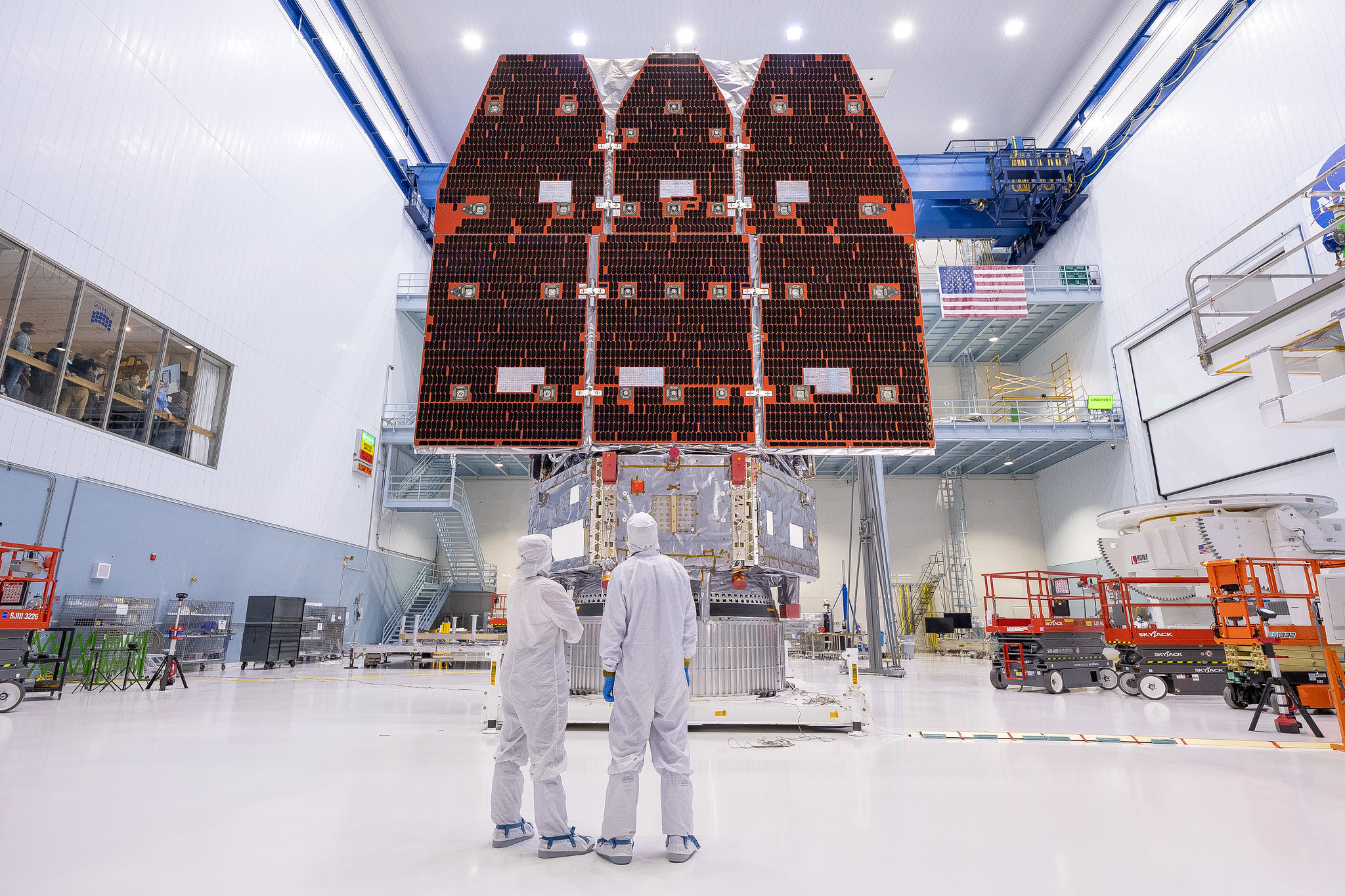
Details
- Vehicle or Subject
- Nancy Grace Roman Space Telescope
- Organization or Agency
- NASA
Release information
Specific presentation details regarding exact viewing platforms and broadcast stream schedules will be shared across official event announcements.
The event marks the public presentation of the first scientific images captured by the orbital observatory following its deployment. Space officials have invited media representatives and the general public to view these inaugural observations, which showcase the instrument's wide-field imaging capabilities.
The release highlights initial milestones achieved after reaching its operational orbit in deep space. These visual results demonstrate the system's operational readiness to begin broad cosmic surveys covering exoplanet discoveries, cosmic expansion, and galactic mapping.
Mission details
The mission serves as a flagship orbital observatory designed to dramatically expand astronomical observations across the universe. Equipped with an expansive field of view, the observatory captures wide panoramic views that span over 100 times the area visible in a single observation by the Hubble Space Telescope. This broad coverage operates at the same high resolution, allowing scientists to gather vast datasets in a fraction of the time required by previous space observatories.
The United States astronomical community designated this project as its highest priority large space mission during the 2010s decadal survey. By repeatedly taking expansive photographs across broad swathes of the sky, the primary scientific instruments support multi-discipline research. These capabilities allow teams to map cosmic structures, discover distant celestial bodies, and track dynamic astronomical events concurrently.
Planetary search capabilities
The observatory is projected to discover thousands of worlds outside the solar system, significantly increasing the total number of cataloged exoplanets. Scientists estimate that transit search techniques could flag between 60,000 and 200,000 candidate planets as they temporarily dim their host stars. Among these targets, researchers anticipate discovering dozens of worlds located within the habitable zones of their respective stars.
In addition to star-orbiting worlds, the mission possesses the sensitivity to detect hundreds of rogue planets drifting through space without a host star. Some of these untethered worlds may be as small as Mars. Beyond distant star systems, observations within our own solar system are expected to reveal hundreds of previously unknown moons surrounding Jupiter, Saturn, Uranus, and Neptune.
Dark energy and cosmology survey
A major scientific objective involves probing the fundamental nature of dark energy, the mystery driving the accelerated expansion of the universe. By mapping more than one billion galaxies across space and time, the mission gathers critical structural data to evaluate how cosmic expansion has evolved over billions of years. This cosmic mapping also aids researchers studying dark matter, which influences galaxy movement and overall universe evolution.
The comprehensive sky survey will document approximately 80,000 Type Ia supernovae, which act as standard distance indicators across deep space. Researchers will also evaluate up to nearly 100,000 cosmic voids to examine matter distribution on the largest scales. These measurements will help physicists test current cosmological models and explore potential undiscovered particle physics.
Launch and operational destination
The observatory lifted off aboard a SpaceX Falcon Heavy rocket from Launch Complex 39A at Kennedy Space Center in Florida. The launch occurred at 7:26 a.m. Eastern Time on August 30, 2026, initiating its trajectory into deep space. Following initial stage separation, the spacecraft successfully separated from its launch vehicle to begin transit toward its orbital station.
The spacecraft operates at Sun-Earth Lagrange Point 2, located approximately 1.5 million kilometers or 930,000 miles away from Earth. This orbital point provides a stable gravitational region with an unobstructed view of deep space. From this location, the observatory maintains continuous communications while executing its multi-year survey operations.
Latest updates
Following successful orbital positioning and commissioning milestones, public invitations were extended to view the first official scientific images produced by the telescope. Media representatives and space science enthusiasts have been invited to participate in the upcoming reveal events hosted by mission leaders.
The initial image release marks the transition from early post-launch setup to active scientific gathering. Researchers around the world anticipate that these inaugural visual releases will demonstrate the observatory's full panoramic capabilities and optical clarity.
Frequently asked questions
- When is Nancy Grace Roman Space Telescope: First Images Reveal?
- Nancy Grace Roman Space Telescope: First Images Reveal is scheduled for Mon, December 7, 2026 at 3:30 PM EST.
- How far away is the telescope operating from Earth?
- The telescope operates at Sun-Earth Lagrange Point 2, which is located approximately 1.5 million kilometers or 930,000 miles from Earth.
- How does the telescope's field of view compare to older space telescopes?
- Its panoramic field of view covers more than 100 times the sky area of a single Hubble Space Telescope image while maintaining the same sharp resolution.
- What rocket was used to launch the observatory into space?
- The observatory was launched aboard a SpaceX Falcon Heavy rocket from Launch Complex 39A at Kennedy Space Center on August 30, 2026.
- How many exoplanet candidates is the mission expected to detect?
- Scientists predict the observatory could identify between 60,000 and 200,000 candidate exoplanets using transit observation methods.
- What time does Nancy Grace Roman Space Telescope: First Images Reveal 2026 release in my timezone?
- The countdown on this page converts Nancy Grace Roman Space Telescope: First Images Reveal 2026 to your local time automatically, so the clock always reflects your own timezone.
Last updated: 11/18/2026